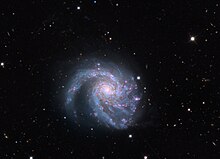
Messier 99 or M99, also known as NGC 4254, is a grand design spiral galaxy in the northern constellation Coma Berenices approximately 15,000,000 parsecs (49,000,000 light-years) from the Milky Way.[4] It was discovered by Pierre Méchain on 17 March 1781. The discovery was then reported to Charles Messier, who included the object in the Messier Catalogue of comet-like objects. It was one of the first galaxies in which a spiral pattern was seen. This pattern was first identified by Lord Rosse in the spring of 1846.[9]
This galaxy has a morphological classification of SA(s)c,[7] indicating a pure spiral shape with loosely wound arms. It has a peculiar shape with one normal looking arm and an extended arm that is less tightly wound. The galaxy is inclined by 42° to the line-of-sight with a major axis position angle of 68°.[5] Four supernovae have been observed in this galaxy: SN 1967H (type II),[10] 1972Q, 1986I (type II),[11] and 2014L (type Ic).[12]
A bridge of neutral hydrogen gas links NGC 4254 with VIRGOHI21, an HI region and a possible dark galaxy. The gravity from the latter may have distorted M99 and drawn out the gas bridge, as the two galaxy-sized objects may have had a close encounter before parting greatly. However, VIRGOHI21 may instead be tidal debris from an interaction with the lenticular galaxy NGC 4262 some 280 million years ago.[5] It is expected that the drawn out arm will relax to match the normal arm once the encounter is over.
While not classified as a starburst galaxy, M99 has a star formation activity three times larger than other galaxies of similar Hubble type that may have been triggered by the encounter.[15] M99 is likely entering the Virgo Cluster for the first time bound to the periphery of the cluster at a projected separation of 3.7°, or around one megaparsec, from the cluster center at Messier 87. The galaxy is undergoing ram-pressure stripping of much of its interstellar medium as it moves through the intracluster medium.[5]