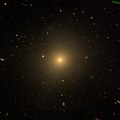
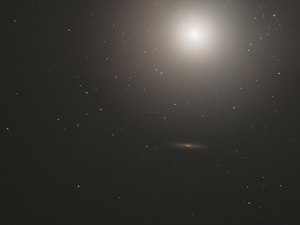
Messier 89 (M89 for short, also known as NGC 4552) is an elliptical galaxy in the constellation Virgo. It was discovered by Charles Messier on March 18, 1781. M89 is a member of the Virgo Cluster of galaxies.[3]
Features
Current observations allow the possibility that M89 may be nearly perfectly spherical. Distinct flattening as ellipsoids is found in all easily measurable comparators up to a few times of its distance. The alternative explanation is that it is an ellipsoid oriented so that it appears spherical to an observer on Earth.
The galaxy features a surrounding structure of gas and dust, extending up to 150,000 light-years and jets of heated particles up to two-thirds of that.[4] This indicates that it may have once been an active quasar or radio galaxy.[4] M89 has an extensive and complex system of surrounding shells and plumes, indicating that it has seen one or several notable mergers.[5]
Chandra studies in the wavelength of the X-Rays show two ring-like structures of hot gas in M89's nucleus, suggesting an outburst there 1 to 2 million years ago[6] as well as ram-pressure stripping acting on the galaxy as it moves through Virgo's intracluster medium.[7] The supermassive black hole at the core has a mass of (4.8±0.8)×108 M☉.[8]
M89 also has a large array of globular clusters. A 2006 survey estimates that there are 2,000 ± 700 of these within 25′. This compares to 150 to 200 of these thought (among which many proven) to surround the Milky Way.[9]