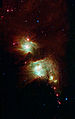
Messier 78 or M78, also known as NGC 2068, is a reflection nebula in the constellation Orion. It was discovered by Pierre Méchain in 1780 and included by Charles Messier in his catalog of comet-like objects that same year.[4]
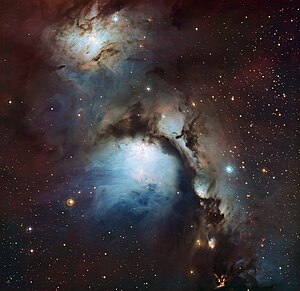
M78 is the brightest diffuse reflection nebula of a group of nebulae that includes NGC 2064, NGC 2067 and NGC 2071. This group belongs to the Orion B molecular cloud complex and is about 1,350 light-years distant from Earth.[2] M78 is easily found in small telescopes as a hazy patch and involves two stars of 10th and 11th magnitude. These two B-type stars, HD 38563 A and HD 38563 B, are responsible for making the cloud of dust in M78 visible by reflecting their light.[5]
The M78 cloud contains a cluster of stars that is visible in the infrared.[2] Due to gravity, the molecular gas in the nebula has fragmented into a hierarchy of clumps,[2] whose cores have masses ranging from 0.3 M☉ to 5 M☉.[6] About 45 variable stars of the T Tauri type,[7] young stars still in the process of formation, are members as well. Similarly, 17 Herbig–Haro objects are known in M78.[8]