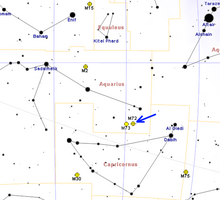
Messier 72 (also known as M72 or NGC 6981) is a globular cluster in the south west of the very mildly southern constellation of Aquarius.

![{\displaystyle {\begin{smallmatrix}\left[{\ce {Fe}}/{\ce {H}}\right]\end{smallmatrix}}}](https://wikimedia.org/api/rest_v1/media/math/render/svg/4c0821bd80891e071c08e7c7ee8e022baedf522c)
Observational history and guide
M72 was discovered by astronomer Pierre Méchain in 1780.[a] His countryman Charles Messier looked for it 36 days later, and included it in his catalog.[8] Both opted for the then-dominant of the competing terms for such objects, considering it a faint nebula rather than a cluster. With a larger instrument, astronomer John Herschel called it a bright "cluster of stars of a round figure". Astronomer Harlow Shapley noted a similarity to Messier 4 and 12.[9]
It is visible in a good night sky as a faint nebula in a telescope with a 6 cm (2.4 in) aperture. The surrounding field stars become visible from a 15 cm (5.9 in)-aperture device. One of 25 cm (9.8 in) will allow measurement of an angular diameter of 2.5 ′. At 30 cm (12 in) the core is clear: its 1.25 ′ diameter, meaning a broad spread; and small parts scarcer in stars to the south and east.[10]
Properties
Based upon a 2011 census of variable stars, the cluster is 54.57 ± 1.17 kly (16.73 ± 0.36 kpc) away from the Sun.[3] It has an estimated combined mass of 168,000[5] solar masses (M☉) and is around 9.5 billion years old. The core region has a density of stars that is radiating 2.26 times solar luminosity (L☉) per cubic parsec.[6] There are 43 identified variable stars in the cluster.[3]