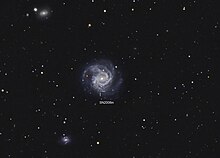
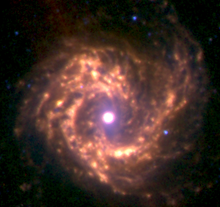
Messier 61 (also known as M61 or NGC 4303) is an intermediate barred spiral galaxy in the Virgo Cluster of galaxies. It was first discovered by Barnaba Oriani on May 5, 1779, six days before Charles Messier discovered the same galaxy. Messier had observed it on the same night as Oriani but had mistaken it for a comet.[5] Its distance has been estimated to be 45.61 million light years from the Milky Way Galaxy.
Properties
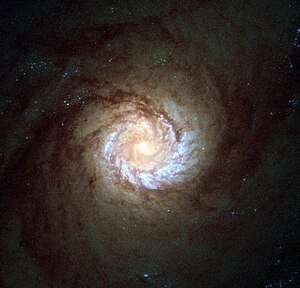
M61 is one of the largest members of Virgo Cluster, and belongs to a smaller subgroup known as the S Cloud.[6][7] The morphological classification of SAB(rs)bc[3] indicates a weakly-barred spiral (SAB) with the suggestion of a ring structure (rs) and moderate to loosely wound spiral arms.[8] It has an active galactic nucleus[9] and is classified as a starburst galaxy containing a massive nuclear star cluster with an estimated mass of 105 solar masses and an age of 4 million years,[10] as well as a central candidate supermassive black hole weighing around 5×10⁶ M☉ solar masses.[11] It cohabits with an older massive star cluster as well as a likely older starburst.[10] Evidence of significant star formation and active bright nebulae appears across M61's disk.[12] Unlike most late-type spiral galaxies within the Virgo Cluster, M61 shows an unusual abundance of neutral hydrogen (H I)[13]
Extragalactic supernovae
Eight extragalactic supernovae have so far been observed in M61, making it one of the most prodigious galaxies for such cataclysmic events.[14][15][5] These include: SN 2020jfo,[16] SN 2014dt, SN 2008in, SN 2006ov, SN 1999gn, SN 1964F, SN 1961I,[15] and the first to be observed, the Type II-K SN 1926A, which appeared on 9 May 1926.[15][17]