Messier 54 (also known as M54 or NGC 6715) is a globular cluster in the constellation Sagittarius.[a] It was discovered by Charles Messier in 1778 and then included in his catalog of comet-like objects.
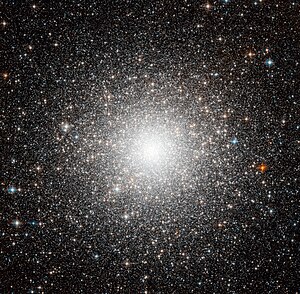
It is easily found in the sky, being close to the star ζ Sagittarii. It is, however, not resolvable into individual stars even with larger amateur telescopes.
Distance
Previously thought to belong to the Milky Way at a distance from Earth of about 50,000 light-years, it was discovered in 1994 that M54 most likely belongs to the Sagittarius Dwarf Elliptical Galaxy (SagDEG),[8] making it the first globular cluster formerly thought to be part of our galaxy reassigned to extragalactic status, even if not recognized as such for nearly two and a quarter centuries. As it is located in SagDEG's center, some authors think it actually may be its core;[9] however others have proposed that it is a real globular cluster that fell to the center of this galaxy due to decay of its orbit caused by dynamical friction.[10]
Modern estimates now place M54 at a distance of some 87,000 light-years,[3] translating into a true radius of 150 light-years across.[5] It is one of the denser of the globulars, being of class III[1] (I being densest and XII being the least dense). It shines with the luminosity of roughly 850,000 times that of the Sun and has an absolute magnitude of −10.0.
Intermediate-mass black hole
In July 2009, a team of astronomers reported that they had found evidence of an intermediate-mass black hole in the core of M54.[11]
