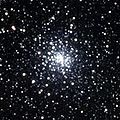
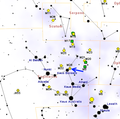
Messier 28 or M28, also known as NGC 6626, is a globular cluster of stars in the center-west of Sagittarius. It was discovered by French astronomer Charles Messier in 1764.[11][a] He briefly described it as a "nebula containing no star... round, seen with difficulty in 31⁄2-foot telescope; Diam 2′."[12]
![{\displaystyle {\begin{smallmatrix}\left[{\ce {Fe}}/{\ce {H}}\right]\end{smallmatrix}}}](https://wikimedia.org/api/rest_v1/media/math/render/svg/4c0821bd80891e071c08e7c7ee8e022baedf522c)
In the sky it is less than a degree to the northwest of the 3rd magnitude star Kaus Borealis (Lambda Sgr). This cluster is faintly visible as a hazy patch with a pair of binoculars[11] and can be readily found in a small telescope with an 8 cm (3.1 in) aperture, showing as a nebulous feature spanning 11.2 arcminutes. Using an aperture of 15 cm (5.9 in), the core becomes visible and a few distinct stars can be resolved, along the periphery. Larger telescopes will provide greater resolution,[5] one of 25 cm (9.8 in) revealing a dense 2′ core, with more density within.[11]
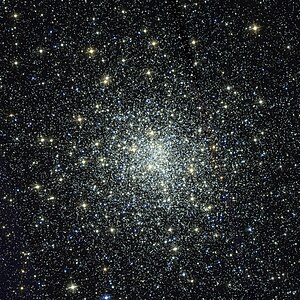
It is about 18,300 light-years away from Earth.[3] It is about 551000 M☉[6] and its metallicity (averaging −1.32 which means more than 10 times less than our own star), coherency and preponderence of older stellar evolution objects, support its dating to very roughly 12 billion years old.[9] 18 RR Lyrae type variable stars have been found within.
It bore the first discovery of a millisecond pulsar in a globular cluster – PSR B1821–24. This was using the Lovell Telescope at Jodrell Bank Observatory, England.[10] A total of 11 further of these have since been detected in it with the telescope at Green Bank Observatory, West Virginia. As of 2011, these number the third-most in a cluster tied to the Milky Way, following Terzan 5 and 47 Tucanae.[13]