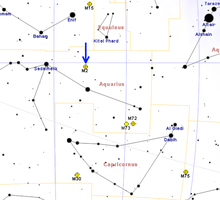
Messier 2 or M2 (also designated NGC 7089) is a globular cluster in the constellation Aquarius, five degrees north of the star Beta Aquarii. It was discovered by Jean-Dominique Maraldi in 1746, and is one of the largest known globular clusters.

![{\displaystyle {\begin{smallmatrix}\left[{\ce {Fe}}/{\ce {H}}\right]\end{smallmatrix}}}](https://wikimedia.org/api/rest_v1/media/math/render/svg/4c0821bd80891e071c08e7c7ee8e022baedf522c)
Discovery and visibility
M2 was discovered by the French astronomer Jean-Dominique Maraldi in 1746[8] while observing a comet with Jacques Cassini.[citation needed] Charles Messier rediscovered it in 1760, but thought it a nebula without any stars associated with it. William Herschel, in 1783, was the first to resolve individual stars in the cluster.[citation needed]
M2 is, under extremely good conditions, just visible to the naked eye. Binoculars or a small telescope will identify this cluster as non-stellar, while larger telescopes will resolve individual stars, of which the brightest are of apparent magnitude 13.1.[citation needed]
Characteristics
M2 is about 55,000 light-years distant from Earth. At 175 light-years in diameter, it is one of the larger globular clusters known. The cluster is rich, compact, and significantly elliptical. It is 13 billion years old and one of the older globulars associated with the Milky Way galaxy.[citation needed]
M2 contains about 150,000 stars, including 21 known variable stars. Its brightest stars are red and yellow giant stars. The overall spectral type is F4.[7] M2 is part of the Gaia Sausage, the hypothesised remains of a merged dwarf galaxy.[9]
Data from Gaia has led to the discovery of an extended tidal stellar stream, about 45 degrees long and 300 light-years (100 pc) wide, that is likely associated with M2. It was possibly perturbed due to the presence of the Large Magellanic Cloud.[10]