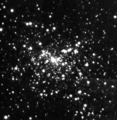
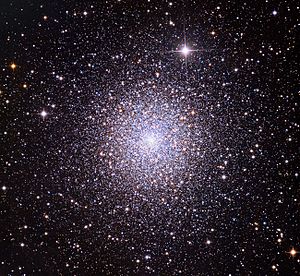
Messier 15 or M15 (also designated NGC 7078) is a globular cluster in the constellation Pegasus. It was discovered by Jean-Dominique Maraldi in 1746 and included in Charles Messier's catalogue of comet-like objects in 1764.[citation needed] At an estimated 12.5±1.3 billion years old, it is one of the oldest known globular clusters.[10]
![{\displaystyle {\begin{smallmatrix}\left[{\ce {Fe}}/{\ce {H}}\right]\end{smallmatrix}}}](https://wikimedia.org/api/rest_v1/media/math/render/svg/4c0821bd80891e071c08e7c7ee8e022baedf522c)
Characteristics
M 15 is about 35,700 light-years from Earth,[3] and 175 light-years in diameter.[11] It has an absolute magnitude of −9.2, which translates to a total luminosity of 360,000 times that of the Sun. Messier 15 is one of the most densely packed globulars known in the Milky Way galaxy. Its core has undergone a contraction known as "core collapse" and it has a central density cusp with an enormous number of stars surrounding what may be a central black hole.[12]
Home to over 100,000 stars,[11] the cluster is notable for containing a large number of variable stars (112) and pulsars (8), including one double neutron star system, M15-C. It also contains Pease 1, the first planetary nebula discovered within a globular cluster in 1928.[13] Just three others have been found in globular clusters since then.[14]
Amateur astronomy
At magnitude 6.2, M15 approaches naked eye visibility under good conditions and can be observed with binoculars or a small telescope, appearing as a fuzzy star.[11] Telescopes with a larger aperture (at least 6 in. (150 mm)) will start to reveal individual stars, the brightest of which are of magnitude +12.6. The cluster appears 18 arc minutes in size (three tenths of a degree across).[11] M15 is 4.2° WNW of the brightest star of Pegasus, Epsilon Pegasi.
X-ray sources
Earth-orbiting satellites Uhuru and Chandra X-ray Observatory have detected two bright X-ray sources in this cluster: Messier 15 X-1 (4U 2129+12) and Messier 15 X-2.[15][16] The former appears to be the first astronomical X-ray source detected in Pegasus.