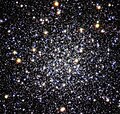
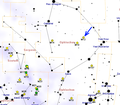
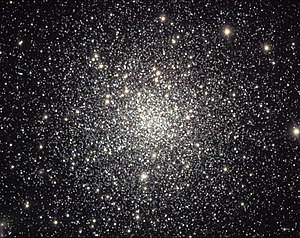
Messier 12 or M 12 (also designated NGC 6218) is a globular cluster in the constellation of Ophiuchus. It was discovered by the French astronomer Charles Messier on May 30, 1764, who described it as a "nebula without stars".[8] In dark conditions this cluster can be faintly seen with a pair of binoculars. Resolving the stellar components requires a telescope with an aperture of 8 in (20 cm) or greater.[9] In a 10 in (25 cm) scope, the granular core shows a diameter of 3′ (arcminutes) surrounded by a 10′ halo of stars.[8]
![{\displaystyle {\begin{smallmatrix}\left[{\ce {Fe}}/{\ce {H}}\right]\end{smallmatrix}}}](https://wikimedia.org/api/rest_v1/media/math/render/svg/4c0821bd80891e071c08e7c7ee8e022baedf522c)
Roughly 3°[9] northwest from the cluster M10 and 5.6° east southeast from star Lambda Ophiuchi, M12 is about 16,400 light-years (5,000 parsecs)[3] from Earth and has a spatial diameter of about 75 light-years. The brightest stars of M12 are of 12th magnitude. With a Shapley-Sawyer rating of IX,[1] it is rather loosely packed for a globular and was once thought to be a tightly concentrated open cluster. Thirteen variable stars have been recorded in this cluster. M12 is approaching us at a velocity of 16 km/s.[10]
A study published in 2006 concluded that this cluster has an unusually low number of low-mass stars. The authors surmise that they were stripped from the cluster by passage through the relatively matter-rich plane of the Milky Way.[11]